
How Much Protein is in the Egg?
Discover the ultimate guide to egg protein. Learn about its high-quality protein content, key health benefits, and how to maximize its nutritional value in your diet.
Discover the ultimate guide to egg protein. Learn about its high-quality protein content, key health benefits, and how to maximize its nutritional value in your diet.

Table of Contents
We live in a world where “quick and easy” is the way to go. Deadline’s loom, commutes crawl, and finding time for a decent breakfast feels like a Herculean task. But what if we told you that a nutritional powerhouse is hiding in plain sight, ready to fuel your day in minutes?
That’s right, we’re talking about eggs – nature’s complete protein-packed gift. Eggs are the ultimate breakfast hack, offering a potent dose of protein that keeps you feeling full and energized long after you’ve left the house. Imagine you’re getting late, but you do not want to miss your breakfast. You whip up a quick egg scramble packed with colourful veggies and a sprinkle of cheese. Suddenly, your morning routine transforms from a frantic scramble into a moment of delicious self-care where you are feeding your body with much needed egg protein.
So, whether you are a fitness enthusiast or just someone who wants to add more protein to their diet, you have come to the right place. This guide will dive deep into the nutritional benefits, explore creative ways to incorporate eggs into your diet, and equip you with the knowledge to make informed choices for a healthier, more energised you.
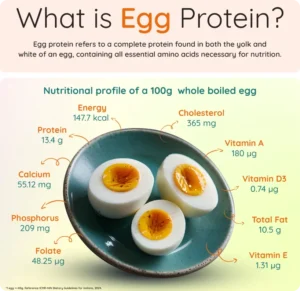
You may be wondering what exactly is egg protein. The term generally refers to the protein composition from both the egg white (albumen) and yolk. While it is common knowledge to associate the protein content with just the egg whites, it is also essential to note that almost 15-17% of the egg protein comes from the humble yolk. They are nutritionally complete proteins containing all the essential amino-acids (EAA). A single egg approximately weighs 40g, containing 5.37g of protein. Two eggs provide nearly 25% of the daily protein requirements of an adult man. Egg proteins also have a great supplementary value. For example, cereal proteins and pulse proteins are poor in certain amino acids. Therefore, a combination of egg with any cereal or cereal pulse mixture enhances the protein quality of food.
Besides protein, lipids, vitamins, and minerals are essentially concentrated in egg yolk. The yolk contains vitamins like A, D & E, K, B1, B2, B5, B6, B9, and B12 along with egg fat which acts like a vehicle for the fat-soluble vitamins to be absorbed. It is interesting to note that Egg yolk is one of the few naturally occurring food sources containing vitamin D. They also contain choline which is an essential nutrient for regulating vital bodily functions along with minerals and trace elements such as phosphorus, calcium, potassium, sodium, copper, iron, magnesium, manganese, selenium, and zinc. Thus, consuming whole eggs as a part of your balanced diet, shall aid in meeting your protein, vitamins, minerals, and trace element requirements. However, do consult a healthcare professional for understanding your daily nutrient requirements better in case of a particular health goal or a medical history. Following is the nutritional profile of a whole boiled egg, weighing 100 g:
| Nutrient | Unit |
| Energy | 147.7Kcal |
| Protein | 13.4g |
| Calcium | 55.12 mg |
| Phosphorus | 209 mg |
| Folate | 48.25 µg |
| Cholesterol | 365 mg |
| Vitamin A | 180 µg |
| Total Fat | 10.5 g |
| Vitamin D3 | 0.74 µg |
| Vitamin E | 1.31 µg |
The egg nutrition value expands through amino acids, minerals, vitamins, and fats. Here are some of the benefits that you may derive from them:
Being a good source of protein and bioactive components, eggs can be a wonderful addition to children’s diet to improve and sustain physical growth, manage malnutrition, and meet the daily protein needs of children. Eggs can also help boost mineral intake. Both the yolk and the white are rich in selenium, making them valuable in fulfilling your mineral needs, especially in children. Additionally, eggs also play a significant role in supporting iodine levels in preschool and school-aged children. Thus, eggs are a low energy, nutrient-dense food source that may contribute to diet quality, particularly intakes of selenium and vitamin D along with protein.
High-quality proteins are known to make a valuable contribution to the synthesis and maintenance of muscle. Therefore, incorporating an adequate amount of egg protein as a part of a balanced diet has been associated with improved skeletal muscle health. Maintaining higher muscle mass also helps to keep the bones strong. For older adults, high quality protein such as that found in eggs may aid in the management of degeneration of skeletal muscles when combined with adequate physical activity.
With a Protein Digestibility Corrected Amino Acid Score (PDCAAS) of 118, eggs are considered an excellent source of high-quality protein. A PDCAAS (Protein Digestibility-Corrected Amino Acid Score) score is a method used to evaluate the quality of protein in a food or ingredient. It considers both the amino acid profile of the protein and how well it is digested by the body.
Adding egg protein to your meals is much easier than you think. Well, it doesn’t have to be just a boiled egg every time. Think creatively and explore the ingredients for the versatile staple that it is. For breakfast, you may fashion some scrambled eggs, a spicy Anda Bhurji with whole wheat roti, or a masala omelette stuffed with vegetables. For lunch, enjoy a comforting Egg Curry with steamed rice or a flavourful Egg Biryani. For dinner, indulge in shakshuka with bread or a simple Egg Drop Soup. Whichever route you choose, the egg protein benefits will never disappoint.